Listening Work, News & Updates, Research
Pulse Check: Trust in Health Care

What is Pulse Check?
Health care is a fundamental part of all people’s lives. Yet, too often, decisions about our health care system are shaped by industry stakeholders and partisan priorities rather than the experiences of the people who rely on it every day. United States of Care was founded to fix that. We listen to people, understand how they experience the health care system in their daily lives, and bring those voices into the decisions that shape policy.
United States of Care has listened to more than 30,000 people for over 5,000 hours across all 50 states. Through these conversations, we hear directly from people, families, and communities in their own words about how they experience the health care system in their daily lives, what they need from the system, and where it is failing them. We analyze these conversations to learn more about key themes that have emerged, coalescing what we’ve heard in a series of insight reports we call “Pulse Checks.”
The Importance of Trust in Health Care
Trust is a fundamental prerequisite to people’s willingness to seek health care. After years of listening to people across the country, one thing is clear: People will not engage with a system they do not trust and the consequences of distrust are direct and costly:
- People avoid seeking care
- They delay treatment until conditions worsen
- Health outcomes suffer
- Care become more expensive for everyone
- Existing health disparities deepen
Trust operates beyond just doctor-patient relationships––it extends to hospitals, insurance companies, pharmaceutical firms, and the entire health care structure. People’s distrust at each level of the system drives reluctance to seek care. Without trust, the health care system fails at its most basic function: keeping people healthy.
The insights that follow reveal what drives mistrust in the health care system and what must change to rebuild it.
THERE ARE DIFFERENT FORMS OF MISTRUST IN HEALTH CARE
People draw a clear distinction between the “system” side (profit-driven forces like pharmaceutical companies, healthcare CEOs, and insurance companies) and the “care” side (doctors and nurses) whom they see as a strength despite challenges in accessing care. People’s lack of trust in these two “sides” of health care are separate and distinct, and stem from different issues.
Why People Do Not Trust The Health Care System
7 in 10 people feel that costs being too high is one of the top issues facing health care.
One word dominates initial impressions of health care: expensive. In our nationwide survey of 1500 registered voters in 2021, 7 in 10 people feel that costs being too high is one of the top issues facing healthcare. Corporate and institutional greed is perceived as the #1 driver preventing access to quality affordable healthcare (more so than system structure, equipment, and technology costs). People perceive a bloated system with greedy and often faceless middlemen (i.e. insurance companies), who they view as profiting off of the system and worse, standing in the way of fixing it. They believe these profits are what drives up the cost of care and add burdensome layers that make it overly complex and overwhelming.
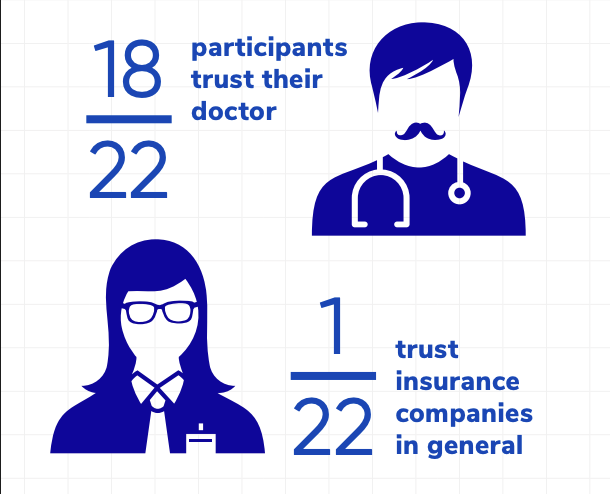
Personal relationships appear to be a main driver of trust in health care. In a focus group with diverse demographics consisting of 22 participants, there was a stark preference for trusting personal doctors over institutional healthcare entities. Specifically, 18 out of 22 participants reported trusting their doctor, while only 1 out of 22 reported trusting insurance companies in general. People similarly reported low levels of trust for pharmaceutical companies and hospital executives. This pattern suggests how personal relationships drive trust in health care, while highlighting the severe trust deficit facing institutional health care corporations, especially the health insurance industry.
Complexity and confusion drive negative sentiment and issues with trust.
People don’t know how much something will
cost when visiting a doctor, and they get told it’ll cost X, when insurance companies end up charging them Y, creating mistrust in a system that seems profit-driven and greedy rather than patient-focused.
do not believe the current fee-for-service model works well.
65% of people we surveyed across the U.S. do not believe the current fee-for-service model works well. When asked about specific aspects of a fee-for service system, the most agreed upon concerns include: providers prioritizing patients with money, ordering unnecessary tests, lack of time with patients, overprescription, doctors rushing, and difficulty affording care. All of these “flaws” contribute to lack of trust in the health care system.
People of color
People of color have lower levels of trust in health care due to mistreatment, being stereotyped, dismissal of concerns, lack of represenation, and language barriers. Mistrust becomes a key driver of hesitancy to see care among these populations.
of people feel concerned, skeptical, or uncertain about the use of AI in health care.
say their feelings about AI in health care come from news or social media.
77% of people feel concerned, skeptical, or uncertain about the use of AI in health care, and 69% say their feelings about AI in health care come from news or social media, indicating how public perception is being shaped about trusting AI. This hesitancy likely stems from limited direct experience with AI in health care settings––most people reorted either not having AI used in their most recent health care visit or being unaware if it was used at all, and the majority were not even aware that AI applications in health care existed. With only 14.7% of people reported experiencing AI in their health care visits, external sources are largely driving most people’s perceptions.
How We Can Rebuild Trust in the Health Care System
- MAKE AFFORDABILITY AND TRANSPARENCY A PRIORITY
Reduce costs and provide clear information about costs and treatment options upfront to increase engagement and prevent the confusion, frustration and financial surprises that damage trust. - REDESIGN CARE MODELS WITH PATIENT-CENTERED FOCUS
Develop new care models that visibly prioritize patient benefit over corporate gain and improve quality of health care delivery. - STRENGTHEN PROVIDER-PATIENT PARTNERSHIPS
Create environments where listening and respect are core clinical values, building more collaborative relationships. - DELIVER WHOLE-PERSON CARE
Move beyond symptom management to address underlying factors to build longer-term patient engagement and better care outcomes. - IMPROVE COMMUNICATION
Encourage clear, accessible language in all medical and financial communications. Reduce medical jargon and replace it with plain language. - BROADEN TREATMENT OPTIONS
People want providers who explore holistic solutions to health problems, not just prescriptions. Incorporate evidence-based approaches like nutrition counseling, physical therapy, and stress management alongside conventional treatments. - ADAPT COMMUNITY-SPECIFIC STRATEGIES
Create targeted approaches for different communities, especially those historically marginalized, rather than using one-size-fits-all solutions.
Why this matters: These priorities represent important opportunities to improve health care delivery. Leaders who implement these changes can build more trusted, effective systems
while improving outcomes and efficiency.
Conclusion
Health care needs to change, and we need to listen to people’s needs. Patients have too often been left out of consideration in the design and implementation of health care payment models. It’s time to recenter the patient experience in building health care policy solutions, and let patient’s voices lead the way to shape how care is paid for and delivered.
SOURCES (8)
1: United States of Care, “National Survey and ReMesh Findings.”January 2022. https://unitedstatesofcare.org/national-surveyand-remesh-findings/.
2: Furtado, K., et al., “A Conceptual Map of Structural Racism in Health Care.” Urban Institute. October 2023. https://www.urban.org/research/publication/conceptual-map-structural-racism-health-care
3: Colorado Rev. Stat. § 10-16-1300.
4: Neumann, K., “Diverse State, Diverse Needs.” Colorado Health Institute. July 2022. https://www.coloradohealthinstitute.org/research/culturally-responsive-care-Colorado
5: Colorado Health Institute, “2023 CHAS: Disrespect in Health Care.” February 2024. https://www.coloradohealthinstitute.org/research/2023-chas-disrespect-health-care
6: United States Census, “QuickFacts: Colorado.” https://www.census.gov/quickfacts/fact/table/CO/PST045223
7: Migration Policy Institute, “State Immigration Data Profiles: Colorado.”
https://www.migrationpolicy.org/data/state-profiles/state/language/CO
8: Flores, A.R., et al., “Adult LGBT Population in the United States.” University of California Los Angeles School of Law – Williams Institute. December 2023. https://williamsinstitute.law.ucla.edu/wp-content/uploads/LGBT-Adult-US-Pop-Dec-2023.pdf
Ready to check out the full Pulse Check?
View the press release for this Pulse Check here.